Clinical nutrition for complex lives. Evidence over opinion.
The clinical dietitian behind The Cancer Treatment Nutrition Guide and The GLP-1 Nutrition Survival Guide, helping GLP-1 patients protect their muscle and people with metabolic conditions eat for the long term.

Jason Fee, MS, RDN, LDNNow accepting new clients
One standard of care,
four ways to work together.
Patients & Clients
GLP-1 & weight-loss nutrition and lifestyle medicine, one-to-one.
Explore care → EmployersCompanies & Teams
Corporate wellness partnerships and GLP-1 employee support.
Explore corporate → Med Spas & ClinicsPractices
Custom, branded GLP-1 client nutrition guides, plus a referral partner for clients who need one-on-one care.
Explore practices →because I needed one.
I found nutrition the hard way. I broke my ankle, and in the process of recovering, doing PT, trying to get back to the life I had, I realized that the only thing that actually moved the needle was how I was eating. Not supplements. Not shortcuts. The science. I wanted to understand the evidence behind it, not just hear people repeat things they couldn't back up. That frustration is what led me to dietetics.
Cancer had been part of my family's story long before I found dietetics. My dad was first diagnosed with lymphoma when I was a child. While I was building that foundation in college, he was re-diagnosed and went through a bone marrow transplant. About six years later, he was diagnosed with prostate cancer and had surgery to remove it. I watched him fight through every round of treatment. I also watched other patients in his cohort lose dangerous amounts of weight, struggle with eating, and in some cases not make it, partly because no one was helping them with the nutrition piece. That changed the direction of my career. I knew I wanted to be in oncology, helping people nourish their bodies through the hardest fight of their lives.
I earned my Bachelor's in Dietetics and then my Master of Science in Kinesiology, Nutrition & Physical Activity from James Madison University, where my thesis applied artificial intelligence and machine learning to dietary assessment, a field I was working in before "AI in healthcare" became a buzzword. I originally planned to run CBD human trials studying inflammatory pathways, but COVID shut that research down, which redirected me to the AI work. I then completed my clinical internship and residency at Virginia Commonwealth University (VCU Health), rotating through inpatient, outpatient, food service systems, administrative nutrition, and legislative policy, with extra rotations in oncology, PhD-level research, and sports nutrition.
From there, I moved into hospital oncology, first inpatient and now outpatient, working in an infusion center with patients during chemo and helping them eat through nausea, fatigue, and fear.
I wrote The Cancer Treatment Nutrition Guide because I couldn't find one. There was no single, comprehensive, evidence-based resource I could hand a patient that covered everything: chemo, radiation, immunotherapy, surgery, symptom management, food safety, and recovery. So I built it. Then a companion for the people doing the cooking, Feeding Someone Through Cancer Treatment (now in English and Spanish). I also wrote The GLP-1 Nutrition Survival Guide because the same thing was happening in the GLP-1 space: patients were being prescribed these medications with almost no nutritional guidance, and losing dangerous amounts of muscle in the process.
That's what Vitae Arete is: the practice I built to do this work on my own terms, evidence-based, radically personal, and grounded in the belief that nutrition done right can change the outcome of someone's life.
Nutrition done right can change the outcome of someone's life.Vitae Arete · A life of excellence
Published in Health Affairs Forefront (July 2026) and Nutrition Today (August 2026) on the U.S. clinical nutrition workforce.
Book a Free Discovery Call



Precision nutrition
for complex lives.
Whether you're losing weight on a GLP-1 or through lifestyle change, or working on your metabolic health, clinical nutrition should meet you where you are.
GLP-1 & Weight Loss
Clinical nutrition support for sustainable weight loss, whether you're on semaglutide, tirzepatide, or pursuing meaningful change through lifestyle and metabolic strategy.
- Muscle preservation and protein strategy
- Metabolic and behavioral nutrition for weight loss
- GI side effect management for GLP-1 users
- Dosing-day meal timing and tolerability
- Long-term maintenance and metabolic baseline
- Alcohol, fasting, and diabetes-specific guidance
Lifestyle Medicine
Precision nutrition to optimize metabolic function, reduce chronic disease risk, and perform at your best, rooted in evidence, not wellness trends.
- Metabolic and biomarker-based nutrition
- Anti-inflammatory eating strategies
- Gut health and microbiome optimization
- Sleep, stress, and lifestyle integration
What's included in each membership.
Memberships include sessions plus everything listed below at one monthly rate. Per-session rates shown for clients who prefer to book individually instead of joining a membership.
All sessions via secure video. HSA/FSA accepted at booking. Super-bills provided for out-of-network reimbursement. Telehealth across Florida and select additional states.
From inquiry to first session in four steps.
One client portal handles everything once you join. No juggling apps, no surprise charges.
Book a free Discovery Call
15 minutes by secure video. We confirm fit, scope, and the right tier. No payment yet.
Choose your membership or session
Pay through my client portal (Practice Better). HSA/FSA cards work like any credit card. Monthly memberships auto-bill on the same date each month. Cancel anytime with two weeks notice.
Complete your intake + lab order
Your portal sends you the intake form and your first lab order. Labs route through my Fullscript dispensary at pass-through pricing, drawn at any Quest near you. Results land back in your portal automatically.
Your first session: fully prepared
By the time we meet, I've reviewed your intake and your labs. Sessions are 45–60 minutes via secure video. Between sessions, you have messaging access at the response time for your tier.
Clinical expertise,
in your hands.
Evidence-based guides written from years at the clinical bedside and GLP-1 consulting practice. No wellness myths. No false promises. Just science, and practical, actionable guidance.
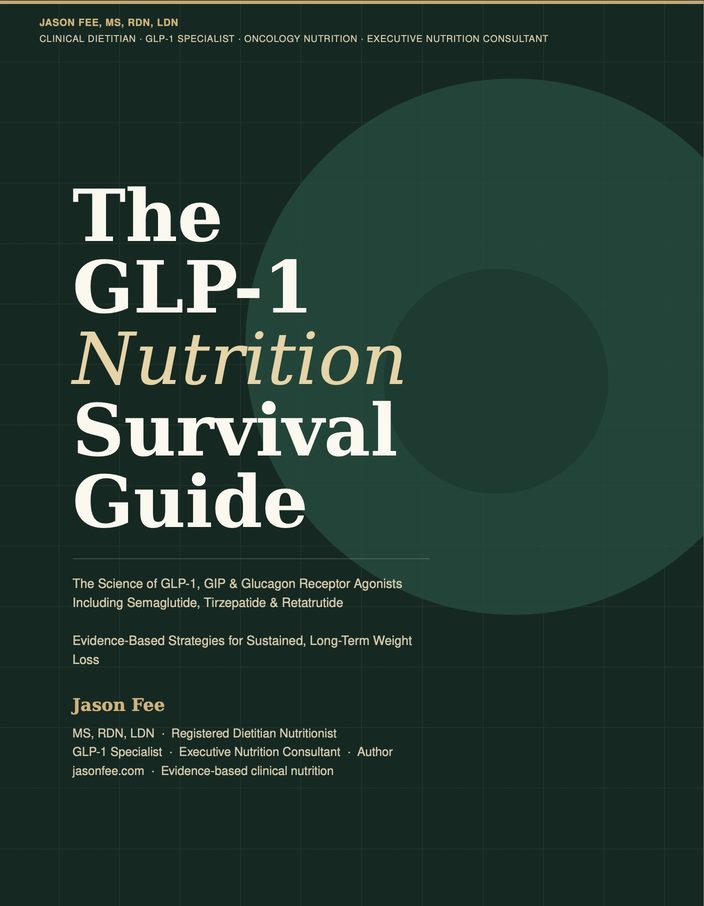
The GLP-1 Nutrition Survival Guide
The science of GLP-1, GIP & glucagon receptor agonists: including semaglutide, tirzepatide, and retatrutide. Evidence-based strategies for protein intake, resistance training, micronutrient gaps, dosing philosophy, and long-term weight maintenance. What your prescriber doesn't have time to explain.
- The science of GLP-1, GIP & glucagon receptor agonist mechanisms
- How much of GLP-1 weight loss is lean mass, and exactly how to protect it
- Protein targets by lean body mass with lookup tables
- Resistance training prescription for GLP-1 users
- Dosing-day meal timing, GI side effect management
- Alcohol, intermittent fasting & diabetes-specific guidance
- Quick Reference Cheat Sheet: protein targets, meal rules, red flags

The Cancer Treatment Nutrition Guide
The only clinical-grade nutrition guide written specifically for cancer patients and their caregivers. Covers all treatment types, 17 symptom toolkits, food safety, and patient worksheets. Written from years at the oncology bedside.
- All treatment types: chemo, radiation, immunotherapy, surgery, hormone therapy
- 17 symptom toolkits: nausea, fatigue, mouth sores, diarrhea, and more
- Food safety guidance for immunocompromised patients
- Patient worksheets, meal trackers, and hydration templates
- Myth-busting: nutrition "rules" you may hear during treatment
- Caregiver companion pages

Feeding Someone Through Cancer Treatment
The caregiver's companion to the Cancer Treatment Nutrition Guide, written for the person doing the cooking. A practical playbook for feeding someone you love when appetite, taste, and energy collapse, through every phase of treatment and recovery.
- What to make when nothing sounds good: symptom-by-symptom meal strategies
- Managing nausea, taste changes, mouth sores, and low appetite at the table
- Food safety for immunocompromised loved ones
- Make-ahead plans, hydration, and energy-dense options for the hard days
- Caring for yourself while you care for them
Protein & Muscle
Planning Calculator
Whether you're losing weight on a GLP-1, maintaining your current body composition, or building muscle in a surplus. Protein requirements differ significantly by goal. This calculator gives you a clinically grounded daily protein target based on your body composition, biological sex, and objective.
Protein targets are anchored to lean body mass (LBM), not total body weight. Ranges vary by goal: 1.4–1.8 g/kg LBM for maintenance, 1.6–2.2 g/kg LBM for weight loss, and 1.8–2.4 g/kg LBM for muscle growth. The weight-loss estimate uses about 26 percent, the share of weight lost that was lean mass in the body-composition substudy of the main tirzepatide trial (SURMOUNT-1; 25 percent on placebo). Lean mass is not all muscle.
Hitting this target every day on a suppressed appetite, while protecting the lean mass you just saw at risk, is where most people need a plan. That is exactly the GLP-1 work I offer, built around your labs and your body composition. The first call is free and there is no intake to fill out.
Book a free 15-min discovery call →Drop your email and I'll send your personalized target, the protein-per-meal lookup table, and a short list of the GLP-1 and muscle-preservation studies this calculator is built on. No spam. Unsubscribe any time.
Daily Energy
Needs Calculator
On a GLP-1, the risk usually isn't eating too much. It's eating too little, and losing muscle along with the fat. This tool gives you a daily calorie floor: the number to eat at least, not a ceiling to stay under. Pair it with your protein target above.
Resting metabolic rate uses the Mifflin-St Jeor equation, the Academy of Nutrition and Dietetics' most accurate default, and switches to Katch-McArdle only when you enter a lab-measured body-fat %. The deficit is percentage-based (never the outdated 3,500-calorie rule), softened by an adaptive-thermogenesis buffer, and clamped to hard safety floors.
Appetite suppression quietly lowers day-to-day movement. When in doubt, pick the lower of two.
DEXA, BodPod, or clinical InBody only. A guessed number makes the estimate worse, so leave it blank.
20% is the sustainable default. Deeper isn't faster on a GLP-1. It's just more muscle lost.
Hitting this every day on a suppressed appetite, while protecting muscle and adjusting as your metabolism shifts, is the real work. That's what I do with GLP-1 patients, built around your labs and body composition. The first call is free.
Book a free 15-min discovery call →General nutrition education, not medical advice or a prescription to restrict. This is not a diagnosis or treatment. Talk with your prescriber before changing how you eat, and never use a calorie number to eat below how your body feels.
Employee wellness that
moves the bottom line.
Most corporate wellness programs are generic, forgettable, and ignored. I build nutrition-forward health partnerships that employees actually use and show up for, because the content is specific, credible, and tied to performance. Tier-priced annual partnerships and à la carte workshops.
The dietitian your
GLP-1 program is missing.
Your clients are on semaglutide and tirzepatide, but without a registered dietitian behind the medication, they lose muscle, stall, and regain. I build the nutrition layer most programs skip: a custom, client-ready GLP-1 guide, authored by an RDN and branded to your practice, plus an ongoing referral path for the clients who need one-on-one care.
Custom, evidence-based GLP-1 nutrition guides your clients actually keep, that make your whole program look more credible, and open a referral path for the clients who need one-on-one care.
Evidence meets everyday living
Clinical perspectives on oncology nutrition, GLP-1 & weight loss, lifestyle medicine, and the science of nourishing a life well-lived.
An independent national analysis of compensation, training, and federal nutrition policy in U.S. clinical dietetics. Why the credential math just broke for Registered Dietitian Nutritionists, and a four-pillar reform framework (PAY · BILL · BUILD · PROTECT) anchored to 84 primary-source citations: BLS OEWS May 2025, the CMS Malnutrition Care Score, the One Big Beautiful Bill Act loan provisions, and OECD international comparators.
Read the analysis →What to Eat on a GLP-1: A Dietitian's Complete Guide
Protein, nausea, fiber, and a realistic day of eating on Ozempic, Wegovy, Mounjaro, or Zepbound: the practical food plan most prescribers don't hand you.
Why I Order Your Labs: And Why DTC Lab Kits Miss the Point
The direct-to-consumer lab market crossed $3B. For the questions clinical nutrition has to answer, DTC kits are the wrong tool. And the panel-selection case is where it shows.
GLP-1 Muscle Loss: How Much of the Weight Is Lean Mass
SURMOUNT trial data on lean mass loss with tirzepatide, and the resistance training + protein protocol that protects it.
The Word “Supplemental” Described a 1975 Economy. This Is the 2026 Economy.
Thirty-eight source-cited, interactive comparisons showing why SNAP and WIC no longer match the economy Americans actually live in.
Common questions, honest answers
Vitae Arete is a private-pay practice. But here's how to use your benefits:
- HSA/FSA cards are accepted at booking, just like any credit card
- Super-bills are provided after every session for out-of-network reimbursement. Many PPO plans reimburse part of the fee, so check your plan's out-of-network benefits
- Tools like Reimbursify can submit your super-bill to your insurance automatically
Direct billing is intentionally avoided so I can spend more time with each client and provide truly individualized care without insurance constraints.
All private consulting sessions are conducted via secure video call, across Florida and select additional states. If you're local to the Orlando, FL area, in-person sessions may be available upon request.
A lot. And it's likely more than your prescriber has time to cover. I specialize in the nutrition side of GLP-1 therapy: building a protein strategy to preserve lean mass (roughly a quarter of GLP-1 weight loss), managing GI side effects, dosing-day meal timing, navigating plateaus, alcohol and fasting interactions, and building a sustainable long-term approach once you reach your maintenance phase.
If you are in treatment, your own oncology team, including its dietitian, is the right first call, because they know your diagnosis, your regimen and your labs. The Cancer Treatment Nutrition Guide and its caregiver companion are written to use alongside that care.
Start your journey toward a life of excellence.
Select a consultation type and choose a time that works for you. All sessions via secure video call on Google Meet.
Book a free Discovery Call or start a membership directly below. The practice is accepting new clients now.
Widget not loading? Open booking page in a new tab →
Prefer to talk before you book?
Memberships and per-session consultations are open now. Book directly above, or leave your details and I'll personally reach out to talk through the right fit. Monthly memberships run GLP-1 $475 · Lifestyle $295, with labs included.
Let's talk about your goals
Whether you have questions about a service, want to discuss your specific situation before booking, or have a media or speaking inquiry. I'd love to hear from you.